Showing posts with label ORGANIC. Show all posts

Tuesday, November 29, 2022

What is Cannizzaro reaction?


 What is Cannizzaro reaction?


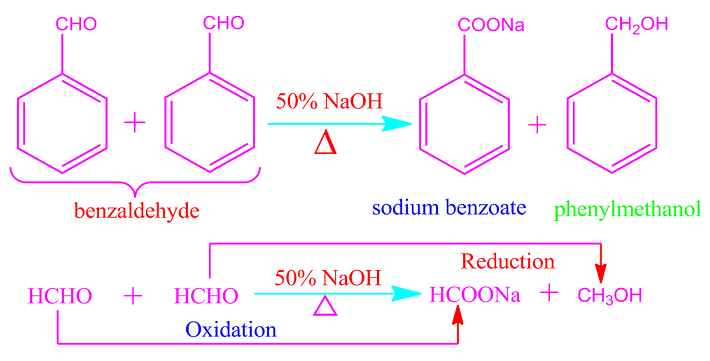
Aldehydes that do not have an alpha hydrogen atom undergo auto-oxidation reduction reactions when heated with concentrated or 50% NaOH or KOH solutions.


That is, half of the participating aldehydes molecules are oxidized to carboxylic acids (as sodium or potassium salt) and half are oxidized to alcohols. This auto-oxidation-reduction reaction is called Cannizzaro reaction. Cannizzaro reaction is also called disproportionation reaction.


Formaldehyde, trimethylacetaldehyde, benzaldehyde or any other aromatic aldehydes participates in the Cannizzaro reaction because of the absence of alpha hydrogen.

What is Cannizzaro reaction?

Saturday, November 12, 2022

Why is Cu2+ ion more stable than Cu+ ion in aqueous solution?


Why is Cu2+ ion more stable than Cu+ ion in aqueous solution?


Many Cu+ compounds are not stable in aqueous solution. These compounds undergo disproportionation reactions to form metallic copper and Cu2+ compounds.


Why is Cu2+ ion more stable than Cu+ ion in aqueous solution?

Monday, September 12, 2022

Why is phenol more acidic than aliphatic alcohols?


 Why is phenol more acidic than aliphatic alcohols?


Phenol is acidic in nature. Because of phenol can donate proton in aqueous solution. Although, phenol is weakly acidic but phenol is more acidic than aliphatic alcohols.


The strength of acid depends on the tendency of donating proton in aqueous solution easily. It has been experimentally found that phenol can donate proton easily than aliphatic alcohols.


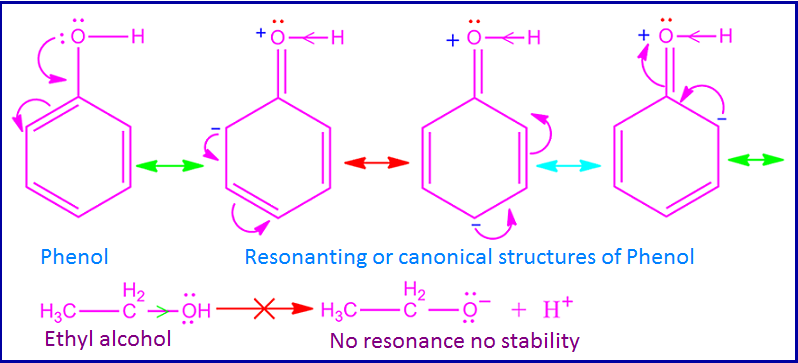
Consequently phenol becomes more acidic than aliphatic alcohols. The acidic properties of phenol can be explained on the basis of its resonance. The lone pair of electron on oxygen atom takes part in resonance with the π electron of benzene ring.


As a result, oxygen atom gets partial positive charge and hence it attracts O – H bonded electron towards itself. Consequently O – H bond become polar as well as weak and release H+ ion easily.


But in case of aliphatic alcohols no such resonance takes place. Hence O – H bond of aliphatic alcohols become stronger than the O – H bond of phenol. Therefore aliphatic alcohols have a very less tendency to donate H+ ion. That is, phenol becomes more acidic than aliphatic alcohols.


It has been experimentally found that phenol is about one million times more acidic than aliphatic alcohols. Phenol reacts with active metals like sodium or potassium and sodium or potassium phenoxide along with hydrogen gas.


Besides of being more acidic than aliphatic alcohol phenol reacts with caustic soda or sodium hydroxide forms sodium phenoxide salt and water. But aliphatic alcohols can’t react with metallic sodium or sodium hydroxide.


Phenol (pKa = 8-10) can turn blue litmus into red, but aliphatic alcohols (pKa = 16–20) cannot turn blue litmus into red.


Why is phenol more acidic than ethyl alcohol?


 Phenol is more acidic than ethyl alcohol. This can be explained on the basis of resonance effect and inductive effect of phenol and ethyl alcohol. The – OH group of phenol has +I effect and also +R effect. But in case of phenol +R effect dominates over +I effect.


Due to this +R effect, the lone of electron on oxygen atom takes part in the resonance with π electron of benzene ring. As a result, oxygen atom of phenol gets partial positive charge.


Why is phenol more acidic than ethyl alcohol?

Wednesday, June 1, 2022

Why do polar solvent and weak nucleophiles favor SN1 reaction?

 Why do polar solvent and weak nucleophiles favor SN1 reaction?


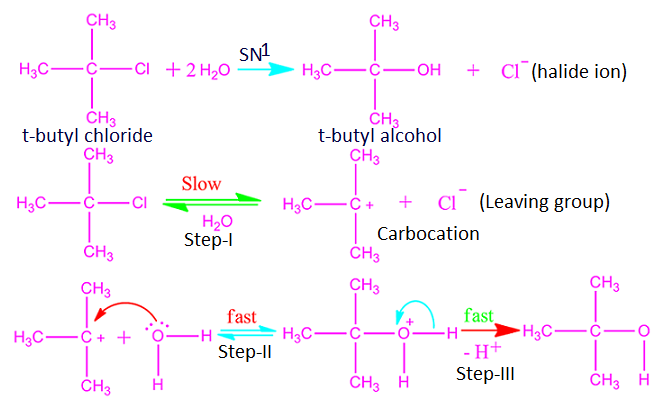
Polar protic solvents, such as CH3OH, CH3CH2-OH, H2O, etc., are suitable for SN1 reactions. This is because in this type of solvent, both carbocation and halide anion gain stability. That is, polar protic solvent favor SN1 reaction mechanism.


Why do polar solvent and weak nucleophiles favor SN1 reaction?

Thursday, May 26, 2022

Why do nucleophiles always attack from backside in SN2 reactions?

 Why do nucleophiles always attack from backside in SN2 reactions?


The SN2 reaction occurs in one step through the backside attack. That is, in this reaction, the nucleophile attacks the carbon atom of the substrate from the opposite side of the living group.


The SN2 reaction is completed through the formation of a transition state. In the transition state, the nucleophile, the carbon and the living group are in the same straight line.


Why do nucleophiles always attack from backside in SN2 reactions?

Thursday, March 17, 2022

What is catenation property of carbon?


What is catenation property of carbon?


Catenation property is found in organic as well as in inorganic compounds. The catenation property mainly shows carbon element in organic chemistry.   


When two or more atoms of an element combine with each other through the covalently single bond, double bond or triple bond to form a long chain structure, then that characteristic of the elements is called catenation property.


What is catenation property of carbon?

Monday, March 14, 2022

What is chiral center or stereogenic center?


What is chiral center or stereogenic center?

Optical isomerism:

The isomerism in which two or more compounds have same physical and chemical properties but they have different behavior towards plane polarized light, are known as optical isomerism and such type of compounds are known as optically active compounds.

Chiral centers:

When a single tetrahedral atom is attached with four different groups or atoms, then traditionally such atoms have been called chiral centers or stereogenic atoms or asymmetric atoms or stereo centers.


For example, the tetrahedral carbon atom of 2-butanol that attached with four different groups is an example of chiral center. Chiral centers are often designated by an asterisk (*) sign.


Sunday, November 14, 2021

What is triphenylphosphine compound?


 What is triphenylphosphine compound?


Triphenylphosphine is a common organophosphorus as well as tertiary phosphine compound with molecular formula C18H15P. It is also expressed as P(C6H5)3 or Ph3P. The molecular weight of triphenylphosphine is 262.29 g / mol.


What is triphenylphosphine compound?

Thursday, November 4, 2021

What is tricyclohexylphosphine in organic chemistry?


What is tricyclohexylphosphine in organic chemistry?


Tricyclohexylphosphine is a tertiary phosphine with chemical formula C18H33P. It is also expressed with the formula P(C6H11)3 or P(Cy)3, where Cy stands for cyclohexyl  group.


Tricyclohexylphosphine is formed by the substitution of three hydrogen atoms by three cyclohexyl group.


What is tricyclohexylphosphine in organic chemistry?

Tuesday, March 23, 2021

What is ethane?


What is ethane?


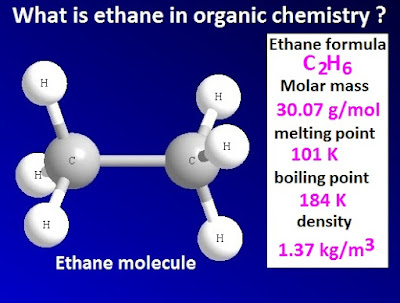
Ethane is an organic compound with molecular formula C2H6. It is a saturated aliphatic hydrocarbon. Ethane is colorless, odorless gas at standard pressure and temperature.


Ethane is mixed with methane in natural gas. Again, a little ethane is also available from coal gas. The melting point of ethane is 101K and the boiling point is 184K.


What is ethane?

Ethane is non polar saturated hydrocarbon. Consequently, it is insoluble or sparingly soluble in water but readily soluble in organic solvents like benzene, ethanol etc.


It burns in air oxygen to form carbon dioxide and water. Ethane is a saturated hydrocarbon and hence it is inert in nature. That is, it does not take part in a chemical reaction normally.

Wednesday, March 3, 2021

What is ethylene glycol in organic chemistry?


What is ethylene glycol in organic chemistry?


Ethylene glycol or glycol, also known as ethane-1, 2-diol, is the simplest dihydric alcohol with molecular formula C2H6O2. It is a colorless, odorless viscous liquid which has a sweet taste.


The IUPAC name of ethylene glycol is ethane-1,2-diol. But it is also known as 1,2-dihydroxyethane, monoethylene glycol, hypodicarbonous acid, ethylene alcohol etc.


What is ethylene glycol in organic chemistry?


It is predominantly used for two purposes. One is the production of polyester fibers and the other as the raw material for antifreeze formulations.


The melting point of ethylene glycol is 260.2 K and the boiling point is 470 K. The high boiling point of ethylene glycol is due to formation of hydrogen bonding with water molecule.

Tuesday, February 9, 2021

Is Methane a greenhouse gas?


Is Methane a greenhouse gas?


Introduction and sources of methane in the atmosphere:


Methane is an aliphatic hydrocarbon compound with chemical formula, CH4. It is also known as an organic greenhouse gas. Methane plays an important role in global warming.


Methane contributes about 14% to global warming. Methane gas enters the atmosphere due to human activities and from natural sources.


Is Methane a greenhouse gas?

For example, CH4 is produced due to decomposition of organic manure applied to paddy fields and other wetlands and entered into the atmosphere.


Again, methane (CH4) is produced and released into the atmosphere by the decomposition of organic compounds from canals and muddy wetlands.

Monday, February 1, 2021

What is methane gas in organic chemistry?


What is methane gas in organic chemistry?


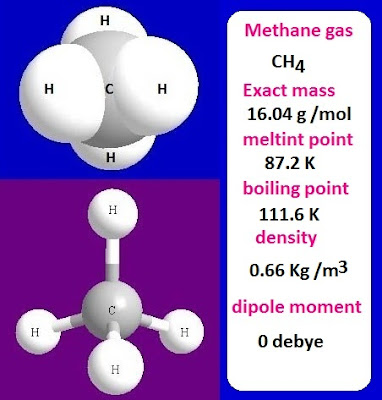
The first compound in the paraffin or alkene class is methane gas. Methane gas is also known as sweet gas or Marsh gas. Its molecular formula is CH4.


Methane gas is the main component of the natural gas that is obtained from underground oil wells. Methane gas is 90% of natural gas.


What is methane gas in organic chemistry?


Methane gas is also found in coal mines. Coal gas produced as a result of internal distillation of wood also contains about 50% methane gas.


Methane gas is not toxic. It is a colorless, odorless, tasteless gas. Methane gas is much lighter than air. Its vapor density is about half that of air vapor density.


Methane is a non polar gas and hence insoluble in water but soluble in organic solvents, such as, alcohol, ether, benzene, acetone, toluene etc.

Saturday, January 9, 2021

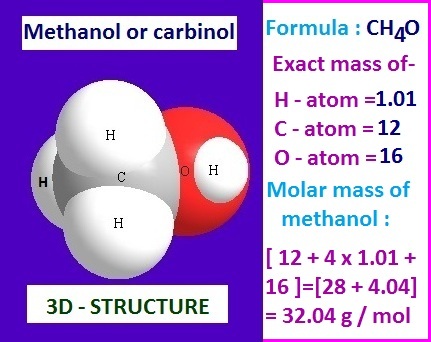
What is the molecular weight of methanol?


What is the molecular weight of methanol?


Methanol, also known as methyl alcohol, is an organic compound with molecular formula CH4O or CH3-OH.


It is simplest aliphatic primary alcohol. Methanol is a colorless, inflammable and poisonous liquid.


What is the molecular weight of methanol?

However, to determine the molecular weight of methanol, first we have to know the molecular formula of the methanol molecule.


Then the number of different atoms in a molecule of methanol has to be determined. Besides, we need to know the atomic mass of different atoms.

Friday, January 1, 2021

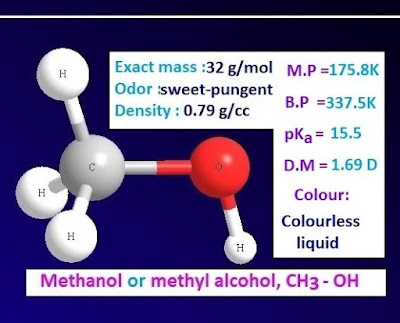
What is methanol or methyl alcohol?


What is methanol or methyl alcohol?


Methanol is a monohydric alcohol of alcohol family. It is the simplest alcohol. Methanol is also known as methyl alcohol or carbinol with chemical formula CH3-OH.


The other names of methanol are hydroxymethane, methylol, wood spirit, wood naphtha, methylene hydrate, pyroligneous spirit etc.


What is methanol or methyl alcohol?

The carbon atom of methanol is attached with three hydrogen atom and one hydroxyl group (-OH) directly.


Methanol is a colorless, sweet and pungent smelling, inflammable liquid. It is poisonousliquid. Melting point of methanol is – 97.8áµ’C and the boiling point is 64.5áµ’C.


Saturday, October 24, 2020

What is synthesis chemical reaction in chemistry?


What is synthesis chemical reaction in chemistry?


The term synthesis was first used by the chemist Herman Kolbe. In chemistry, chemical synthesis is the synthesis of useful chemicals by artificial means.


These reactions consist of few steps to produce product from reactants. These chemical reactions are known as synthesis chemical reaction.


In other words, the chemical reactions through which one more reactants are combined to produce essential compounds, that is, the chemical reactions those are relating to synthetic synthesis, is called synthesis chemical reaction.


In chemical synthesis, one or more reagents or reactants are added under certain conditions to form a productive substance.


For example, a laboratory synthesis of paracetamol may consist of three separate synthetic steps.


What is synthesis chemical reaction in chemistry?

The desired product is made through synthesis chemical reaction. There are many techniques in chemical synthesis. Each chemical synthesis is multistep synthesis.


A large number of organic as well as inorganic compounds are synthesized by using synthesis chemical reaction.


Thursday, October 15, 2020

What is oxidation of iron in inorganic chemistry?


What is oxidation of iron in inorganic chemistry?


The standard reduction potential of iron is -0.44 volt which is less than alkali metals and alkaline earth metals.


Therefore, oxidation of iron metal is not so easy with respect to the above said metals. But oxidation of iron takes place under certain conditions.


Oxidation of iron may occur naturally as well as by artificially. However, oxidation of iron takes place in the presence of air or oxygen and forms ferric oxide, ferrosoferric oxide, ferrate etc compounds.


There is no reaction of iron with dry air. But iron in humid air is oxidized by oxygen of air.

This results in a brown coating on the iron, called rust. Rust is hydrated ferric oxide. Its symbol is Fe2O3.3H2O.


The oxidation number of iron in this compound is +2. That is, the iron has lost two electrons. So the iron has been oxidized. This is natural oxidation of iron.


Oxidation of iron reaction equation


What is oxidation of iron in inorganic chemistry?

Tuesday, October 6, 2020

What is oxidation of ethene in organic chemistry?


What is oxidation of ethene in organic chemistry?


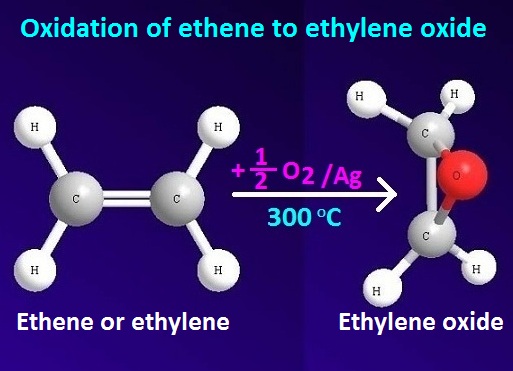
Oxidation of ethene or ethylene is an important chemical reaction in organic chemistry. Because, on oxidation of ethene produces ethylene oxide which is very important synthetic reagent.


There are different methods for oxidation of ethene. The various methods for oxidation of ethene are discussed below individually.


Oxidation of ethene by oxygen to ethylene oxide or epoxide


Oxidation of ethene takes place in presence of oxygen by using silver catalyst at 300áµ’C temperature. The resulting product is known as epoxy alkane or epoxide.


What is oxidation of ethene in organic chemistry?

Thursday, October 1, 2020

What is hydrolysis reaction in chemistry with examples?


What is hydrolysis reaction in chemistry with examples?


The hydrolysis reaction is an important reaction in chemistry. Many organic and inorganic compounds participate in hydrolysis reactions.


This is a very important reaction, especially in the case of organic compounds.

Hydrolysis is a chemical reaction in which a molecule of water dissociates one or more chemical bonds.


Hydrolysis reactions can be called reversals of the condensation process where two molecules combine together into a larger one and emit a water molecule.


The term hydrolysis is widely used for substitution, elimination and salvation reactions where water is a nucleophile.

Tuesday, June 30, 2020

Acid rain definition in environmental chemistry


Acid rain definition in environmental chemistry


Acid rain is one type of rain or any other form of precipitation with acidic components [HNO3, H2SO4, HCl, H2CO3, HNO2 etc] that fall to the ground from the atmosphere with rain water.

When some non metallic acidic oxide such as SO2, NO2, HCl etc gaseous substances are mixed with dew, snowfall and rain water, forming sulfuric acid, nitric acid and hydrogen chloride come down on the earth from atmosphere, then this phenomenon is called acid rain.

The effect of acid rain is less in India. The incidence of acid rain is highest in European countries, United state, Canada, china etc.

Because, acid rain is directly related to the airpollution and the level of pollution is highest in these countries.


Acid rain definition in environmental chemistry