Showing posts with label ORGANIC. Show all posts

Tuesday, November 29, 2022

What is Cannizzaro reaction?


 What is Cannizzaro reaction?


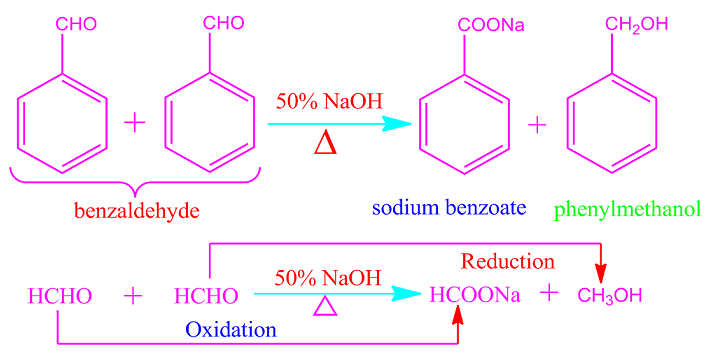
Aldehydes that do not have an alpha hydrogen atom undergo auto-oxidation reduction reactions when heated with concentrated or 50% NaOH or KOH solutions.


That is, half of the participating aldehydes molecules are oxidized to carboxylic acids (as sodium or potassium salt) and half are oxidized to alcohols. This auto-oxidation-reduction reaction is called Cannizzaro reaction. Cannizzaro reaction is also called disproportionation reaction.


Formaldehyde, trimethylacetaldehyde, benzaldehyde or any other aromatic aldehydes participates in the Cannizzaro reaction because of the absence of alpha hydrogen.

What is Cannizzaro reaction?

Saturday, November 12, 2022

Why is Cu2+ ion more stable than Cu+ ion in aqueous solution?


Why is Cu2+ ion more stable than Cu+ ion in aqueous solution?


Many Cu+ compounds are not stable in aqueous solution. These compounds undergo disproportionation reactions to form metallic copper and Cu2+ compounds.


Why is Cu2+ ion more stable than Cu+ ion in aqueous solution?

Monday, September 12, 2022

Why is phenol more acidic than aliphatic alcohols?


 Why is phenol more acidic than aliphatic alcohols?


Phenol is acidic in nature. Because of phenol can donate proton in aqueous solution. Although, phenol is weakly acidic but phenol is more acidic than aliphatic alcohols.


The strength of acid depends on the tendency of donating proton in aqueous solution easily. It has been experimentally found that phenol can donate proton easily than aliphatic alcohols.


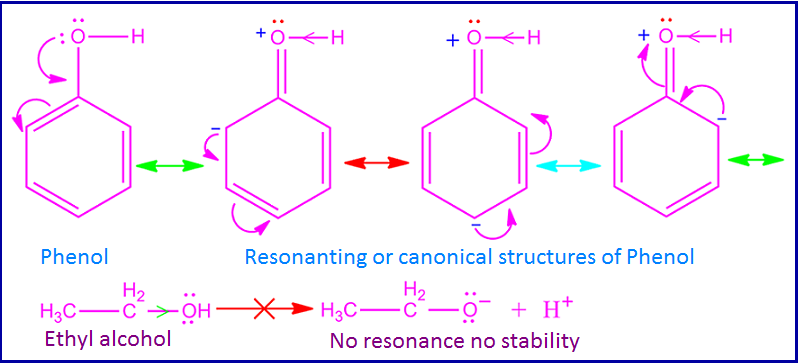
Consequently phenol becomes more acidic than aliphatic alcohols. The acidic properties of phenol can be explained on the basis of its resonance. The lone pair of electron on oxygen atom takes part in resonance with the π electron of benzene ring.


As a result, oxygen atom gets partial positive charge and hence it attracts O – H bonded electron towards itself. Consequently O – H bond become polar as well as weak and release H+ ion easily.


But in case of aliphatic alcohols no such resonance takes place. Hence O – H bond of aliphatic alcohols become stronger than the O – H bond of phenol. Therefore aliphatic alcohols have a very less tendency to donate H+ ion. That is, phenol becomes more acidic than aliphatic alcohols.


It has been experimentally found that phenol is about one million times more acidic than aliphatic alcohols. Phenol reacts with active metals like sodium or potassium and sodium or potassium phenoxide along with hydrogen gas.


Besides of being more acidic than aliphatic alcohol phenol reacts with caustic soda or sodium hydroxide forms sodium phenoxide salt and water. But aliphatic alcohols can’t react with metallic sodium or sodium hydroxide.


Phenol (pKa = 8-10) can turn blue litmus into red, but aliphatic alcohols (pKa = 16–20) cannot turn blue litmus into red.


Why is phenol more acidic than ethyl alcohol?


 Phenol is more acidic than ethyl alcohol. This can be explained on the basis of resonance effect and inductive effect of phenol and ethyl alcohol. The – OH group of phenol has +I effect and also +R effect. But in case of phenol +R effect dominates over +I effect.


Due to this +R effect, the lone of electron on oxygen atom takes part in the resonance with π electron of benzene ring. As a result, oxygen atom of phenol gets partial positive charge.


Why is phenol more acidic than ethyl alcohol?

Wednesday, June 1, 2022

Why do polar solvent and weak nucleophiles favor SN1 reaction?

 Why do polar solvent and weak nucleophiles favor SN1 reaction?


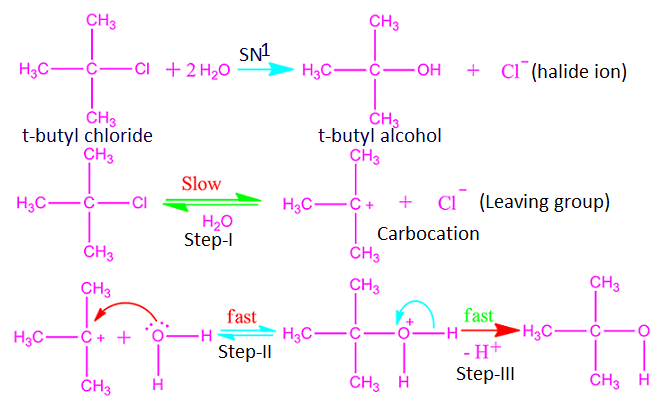
Polar protic solvents, such as CH3OH, CH3CH2-OH, H2O, etc., are suitable for SN1 reactions. This is because in this type of solvent, both carbocation and halide anion gain stability. That is, polar protic solvent favor SN1 reaction mechanism.


Why do polar solvent and weak nucleophiles favor SN1 reaction?

Thursday, May 26, 2022

Why do nucleophiles always attack from backside in SN2 reactions?

 Why do nucleophiles always attack from backside in SN2 reactions?


The SN2 reaction occurs in one step through the backside attack. That is, in this reaction, the nucleophile attacks the carbon atom of the substrate from the opposite side of the living group.


The SN2 reaction is completed through the formation of a transition state. In the transition state, the nucleophile, the carbon and the living group are in the same straight line.


Why do nucleophiles always attack from backside in SN2 reactions?