
Oxidation agent definition with examples in chemistry
In a chemical reaction, if a substance oxidizes another
substance but reducing itself then it is called an oxidation agent or oxidant.
The
oxidation agent or oxidant oxidizes
the other substance by rejecting the electrons, and accepting those electrons
be reduced by itself.
For
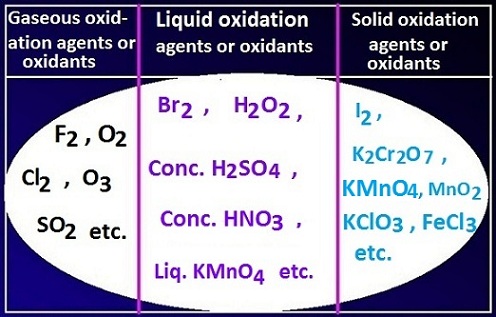
examples, fluorine (F2), chlorine (Cl2), oxygen (O2), ozone (O3), potassium
permanganate (KMnO4), potassium dichromate (K2Cr2O7) etc.
What are the various types of oxidation agent?
There
can be three types of oxidation agent
or oxidant depending on the state of matter, such as solid oxidation agents,
liquid oxidation agents, and gaseous oxidation agents.
Depending
on the strength, there are another two types of oxidation agent or oxidant, such as strong oxidation agent and weak or mild oxidation agent.
Oxidation agent examples list


